
Common Garden Weeds in the UK
How to identify the twelve weeds you will actually meet, and how to remove each one without a single chemical.
How to identify the twelve weeds you will actually meet, and how to remove each one without a single chemical.
Weeding is the job that never quite ends, and it is one of the most common reasons people across South East London call us in. The good news is that almost every weed you will meet is one of about a dozen usual suspects, and once you can name them, dealing with them is far less of a battle. You do not need a single chemical to win it either.
This guide walks through the common garden weeds in the UK you will actually find in a London garden, how to tell them apart, and how to remove each one the wildlife-friendly way. It is the same approach we use weeding borders and beds across South East London every week.
Before you can deal with a weed, it helps to know which of two camps it is in, because the two are removed completely differently. The Royal Horticultural Society splits common garden weeds into annuals and perennials, and once you can place a weed in one of these, the right action is usually obvious:
Here is the honest part. You will never have a permanently weed-free garden, and anyone promising one is selling you chemicals you do not need. The realistic aim is borders and beds that are kept on top of, a wild corner that earns its keep for wildlife, and knowing the dozen weeds below well enough to act before they take hold.
The reflex with weeds is to spray them. It feels decisive, but a weedkiller does not stop at the weed. We have watched a serious decline in insects across the gardens we work in, and in the small birds and other wildlife that depend on them, and the steady creep of weedkillers and other garden chemicals is very likely part of that story. A border is a tiny piece of habitat, and we are not willing to poison it to save ten minutes of pulling.
There is a practical case too. Sprays kill the leaves but rarely the deep roots of a perennial, so bindweed and ground elder are back within weeks, and you have damaged the soil life that keeps the rest of the border healthy. Hand removal and mulching are slower to start but they actually work, and they leave the soil better, not worse.
The RHS confirms that every garden weed, with the single exception of Japanese knotweed, can be controlled without chemicals. That is exactly how we work, on every garden, every time. The rest of this guide is how.
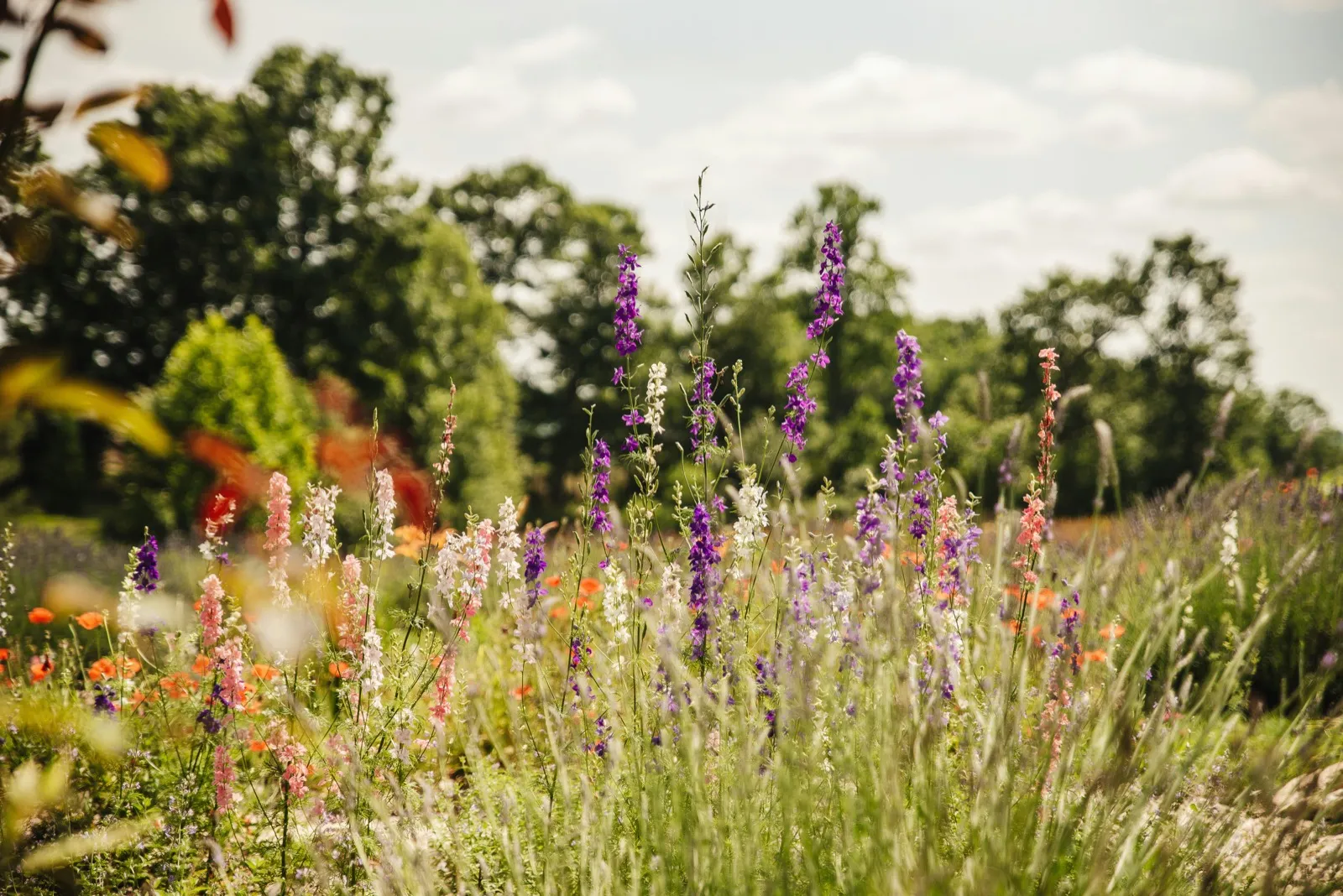
The hardest thing about weeds is not any single one of them, it is the relentlessness. Turn your back for a fortnight and the borders are away again. Our garden maintenance visits exist for exactly this: regular, no-chemical weeding of the borders and beds so the garden stays ahead of it rather than always behind, with a wild corner left for the wildlife.
Every weed below is dealt with using one of four methods the RHS sets out for non-chemical weed control. Hand pulling and hoeing for annuals, caught young before they seed. Digging out the entire root for perennials, because anything left behind regrows. Repeated cutting of the top growth to slowly starve the deepest-rooted offenders. And smothering cleared ground with a thick organic mulch so new seedlings never get the light to start.
The mulch step is the one most people skip and it is the one that changes everything. Bare soil is an open invitation; a generous layer of organic matter shuts the door on new weeds and, on the heavy clay across South East London, steadily improves the soil underneath. Clearing without mulching is just signing up to do it all again.
With those four tools in mind, here are the twelve weeds you will actually meet, and exactly which method each one needs.
These are the weeds we actually pull in South East London gardens, in roughly the order you will meet them: the fast annuals first, then the perennials that need real persistence. For each one, how to know it and exactly what to do.
A low, sprawling mat of small bright-green leaves with tiny white star flowers, soft and quick to appear on any bare or recently dug soil. It is an annual, so the only rule that matters is to hoe or hand-pull it before it flowers and seeds. Caught early it comes away in seconds; left to seed, you will be pulling it all season.
A small rosette of round leaflets with a thin flowering spike. Its trick is explosive seed pods that fire seed metres when you brush past, so it spreads fast through borders and pots. Pull or hoe it the moment you see the rosette, well before the seed heads form. It is shallow-rooted and easy if you are not late.
Also called sticky willy or goosegrass. Scrambling stems covered in tiny hooks that cling to everything and whorls of narrow leaves. An annual that grows alarmingly fast in spring. Pull whole handfuls out before it climbs through your shrubs and sets its sticky seed; the roots are weak so it lifts easily.
A pale, low tufted grass that seeds even when mown very short, so it turns up in lawn edges, borders and gravel alike. As an annual it is all about the seed: hoe it out of beds while small and keep it from seeding into borders from a tatty lawn edge. Persistent rather than difficult.
Everyone knows the yellow flower and clock seed head; the part that matters is the long, brittle taproot. Snap the top off and it simply regrows. Lever the entire taproot out with a hand fork or daisy grubber when the soil is damp. The flowers are valuable early bee food, so we are happy to leave some in a wild area and only clear them from borders and lawns.
Glossy, lobed leaves and bright yellow flowers, spreading by runners that root wherever they touch down, so one plant quietly becomes a colony across a damp border. Fork out the whole network of runners and roots, especially on the wet clay it loves across South East London, and mulch afterwards to slow its return.
White trumpet flowers and arrow-shaped leaves on stems that twist up through everything. The roots are deep, white and brittle, and every fragment left behind becomes a new plant, which is why it is one of the hardest. Dig out as much root as you can, then keep pulling or cutting every new shoot to starve it. This is a season-long campaign, not a single afternoon.
Spreading patches of toothed, divided leaves and, later, umbrella heads of white flowers. It runs underground on a dense mat of white rhizomes and regrows from any piece. Dig the soil over and tease out every length of rhizome you can find, then mulch heavily and remove regrowth on sight. Persistence, not chemicals, is what beats it.
A coarse, fast grass that invades borders from lawn edges on tough, far-reaching white roots. Snapped roots resprout, so it has to be forked out whole, following each root run rather than just tugging the leaves. A proper deep border edge is the best long-term defence, which is part of what a maintenance visit puts back.
No introduction needed. Tough yellow roots that spread sideways and regrow from fragments. Dig clumps out fully where you need the space. But nettles are one of the most valuable wildlife plants there is, feeding the caterpillars of several butterflies, so we will almost always suggest keeping a patch in a wild corner and only clearing them from the working borders.
Bristly, coarse leaves and pretty bright-blue forget-me-not flowers that fool people into leaving it, then a deep, thick taproot that makes it very hard to shift later. Dig young plants out with the full taproot before they establish. Mature ones take real effort, so the trick is not to let new seedlings get away with it.
Primitive, jointed stems like tiny fir trees, from roots that go down further than you can realistically dig. The RHS notes it is one of the few weeds you manage rather than eliminate. Repeatedly pull or cut every shoot to weaken it over time, mulch hard, and accept that control, not eradication, is the honest goal here.
The single best time to weed is little and often, all through the growing season, catching annuals before they seed and perennials before they bulk up. The most valuable session is an early one in spring, clearing the first flush before it sets seed and saves you months of follow-up.
Weeding is also easiest when the soil is damp, because roots slide out whole rather than snapping. That matters more than usual here: the heavy clay across South East London bakes hard and cracks in summer, and a snapped bindweed or dandelion root in dry clay is a guaranteed regrowth. Weed after rain, not in a drought.
That same clay is why mulching matters so much locally. A thick organic mulch suppresses new weeds and slowly turns sticky London clay into something that both your plants and your back will thank you for, so every clearing visit also leaves the soil better than it found it.
People imagine a good gardener leaves a garden with not a single weed in it. That is not the goal, and chasing it is how gardens end up sprayed and lifeless. A weed is only a weed where you do not want it. The same nettle that has no place in a planted border is feeding butterfly caterpillars in a wild corner two metres away.
So the realistic, honest picture is this: borders and beds kept genuinely on top of, the worst perennials steadily worn down rather than magically gone overnight, and a deliberately wild patch left for the wildlife that makes the rest of the garden work. A garden that is alive and largely weed-free beats a sterile one that is completely weed-free, every time.
The only real mistake is the one nearly everyone makes: clearing bare soil and then leaving it bare. Bare soil does not stay bare, it grows weeds. Clear, then mulch, then keep on top of it. That order is the whole game.
You can absolutely do a lot of this yourself, and the annuals especially are a job anyone can stay on top of with ten minutes and a hoe. The hard part is not knowledge, it is relentlessness: keeping pace through the season and having the patience to exhaust a deep-rooted perennial over months rather than giving up and reaching for a spray.
If you would rather it was simply kept on top of for you, that is what our garden maintenance visits are for. The same named gardener every visit, no chemicals ever, the priority areas tackled first, a wild corner protected for wildlife, and your garden guaranteed to be tidier than we found it.
One fixed price, no quotes, no surprises. Your gardener Josh tackles the priority areas first, weeds the borders and beds, and leaves a handwritten plan for staying on top of it. The same named gardener every visit, never a chemical in sight.
There is no single one, but the weeds we pull most often in South East London gardens are chickweed, hairy bittercress, cleavers, dandelion, creeping buttercup, bindweed and ground elder. The RHS groups them into annuals, which are shallow-rooted and easy to pull, and perennials, which keep coming back from the root and take persistence.
The RHS confirms every garden weed except Japanese knotweed can be controlled without chemicals. Annuals are hoed or hand-pulled before they seed. Perennials are dug out with the whole root, or weakened by repeatedly cutting off the top growth, and the soil is then mulched to suppress what is left. We never use chemicals on any garden, ever.
An annual weed such as chickweed or bittercress lives one season and spreads only by seed, so the trick is removing it before it sets seed. A perennial such as bindweed, ground elder or dandelion survives in the roots year on year, so it has to be dug out completely or steadily exhausted, which can take more than one season.
Often, yes. The RHS points out many plants we call weeds have real value for wildlife. Nettles feed butterfly caterpillars and dandelions are an early nectar source for bees. We usually keep a deliberately wild corner of nettles and rougher growth and weed the borders and beds, so the garden stays both tidy and alive.
Almost always because a perennial weed was snapped off rather than dug out. Bindweed, ground elder, couch grass and dandelion all regrow from any root fragment left behind. The lasting answer is to remove the whole root system, then mulch the soil so new seedlings cannot establish, and stay on top of it.
Yes. The RHS lists a thick organic mulch as one of the most effective non-chemical controls. A generous layer of organic matter on cleared soil blocks the light weed seeds need to germinate, and on our heavy South East London clay it improves the soil at the same time, so the border gets healthier as it gets cleaner.
Weeding is part of our garden maintenance service, which is a fixed £249 for a 3-hour visit with no travel charges anywhere in South East London. We tackle the priority areas first, weed the borders and beds, and leave a handwritten plan for keeping on top of it between visits.
For the full step-by-step method on staying ahead of them, read our how to get rid of weeds in the garden guide. To see how regular weeding fits into a visit, visit our garden maintenance service page.
Book online in 60 seconds. Instant confirmation, transparent pricing, no quotes needed.